
Career Focused
Employment Ready Degrees
In alignment with the National Education Policy (NEP) 2020 and to bridge the critical gap between academia and industry, the UGC has introduced the Apprenticeship Embedded Degree Programme (AEDP). This initiative is aimed at embedding real-world industry training into undergraduate degree courses, thereby creating a structured pathway for students to become employment-ready even before graduation.
The AEDP is designed as a student-centric, industry-integrated learning model, which allows students to undertake apprenticeship training as an essential component of their academic curriculum. This blend of classroom knowledge and hands-on industrial experience enhances their employability, fosters practical skills, and builds confidence for the workforce.
Why implement
Compelling Reasons for Your Institution
Six compelling, policy-backed reasons to adopt AEDP and position your institution at the frontier of outcome-based, industry-integrated education.
Enhance Employability of Graduates
AEDP enables students to graduate with both academic knowledge and work experience. This significantly improves employment chances and aligns with the government's vision of a skill-driven workforce.
Boost Institutional Rankings & Reputation
Offering AEDP demonstrates a commitment to industry-relevant education, experiential learning, and outcome-based teaching — key criteria in NAAC and NIRF accreditation frameworks.
Strengthen Industry Collaboration
AEDP necessitates formal partnerships with industries, fostering robust academia-industry linkages and making your institution the preferred choice for recruiters and collaborators.
Curriculum Flexibility & Modernisation
Redesign existing programmes with flexible structures, multiple entry-exit points, and multidisciplinary learning aligned with the National Credit Framework (NCrF) and NHEQF.
Additional Stipend Support for Students
Industries engaging with AEDP provide stipends during apprenticeship periods, reducing financial burden on students and incentivising academic performance.
Access to Government Support
Through NATS (National Apprenticeship Training Scheme), institutions access technical and administrative support while industries receive reimbursement under NAPS.
Institutional value
Institutional Benefits of Implementing AEDP
AEDP creates measurable, multi-dimensional value for your institution — from new revenue streams to national recognition.
Additional Revenue Streams for the College
Higher Student Enrolment
AEDP offers a unique value proposition that differentiates the college from traditional degree providers. Students and parents prefer programmes with industry training and stipends, leading to increased enrolments across streams.
Premium Pricing for Industry-Integrated Programmes
AEDP courses can command premium fees over conventional degree programmes due to guaranteed apprenticeships and real-world exposure, creating a stronger revenue model.
Industry Partnership Grants & CSR Collaborations
Colleges implementing AEDP can attract funding from industry partners through CSR initiatives, skilling budgets, and capacity-building funds to set up labs, training centres, and employ faculty.
Government Incentives & Schemes
Through NAPS and the NATS portal, colleges benefit indirectly through capacity-building support and incentives routed to institutions aligned with national skilling goals.
Higher Admissions & Competitive Advantage
Parent & Student Preference
In a competitive education environment, AEDP stands out. It ensures industry exposure, employability, and stipends — more attractive than regular degrees. This directly leads to higher admissions and reduced dropout rates.
Preferred Destination in the Region
Colleges offering AEDP distinguish themselves from purely academic programmes. Students from other regions or districts may willingly travel or relocate for such industry-integrated opportunities.
Multiple Entry-Exit Attracts Non-Traditional Students
Flexibility to exit and rejoin (per UGC's Curriculum and Credit Framework) attracts students with financial or personal constraints — widening the learner base to include working professionals, women returnees, and rural learners.
Reputation, Accreditation & National Recognition
NAAC & NIRF Scoring Advantage
AEDP contributes directly to "employability, innovation, and industry linkages" — all key parameters in NAAC accreditation and NIRF rankings — helping the college improve its grade, score, and overall national standing.
Stronger Alumni Outcomes & Placements
Colleges implementing AEDP have better student placement records and industry-ready alumni. These tangible outcomes build a stronger institutional reputation among all stakeholder
First-Mover Advantage in the Region
Being among the first colleges in the locality or state to offer UGC-compliant AEDPs provides a branding edge. Media coverage, student testimonials, and employer feedback can be leveraged for publicity and outreach
Student value
Benefits of AEDP for Students
Students gain far more than a degree — they graduate with work experience, financial support, industry networks, and complete academic mobility.
Industry Exposure While Studying
Students work in real industry settings as part of their degree — no waiting until after graduation. They learn the latest tools, technologies, practices, and soft skills valued by employers.
Financial Independence Through Stipend
Students receive a monthly stipend during apprenticeship training through industry or government support. This makes education more affordable and motivates consistent performance.
Faster & Higher Employability
AEDP students build practical skills and professional networks while studying, making them more likely to be hired at higher salaries. Companies prefer such graduates as they require less onboarding and training.
Higher Education Opportunities Remain Open
AEDP degrees are treated at par with regular UG degrees by UGC and are valid for Master's and PhD admissions, ensuring complete academic mobility despite the vocational integration.
How it works
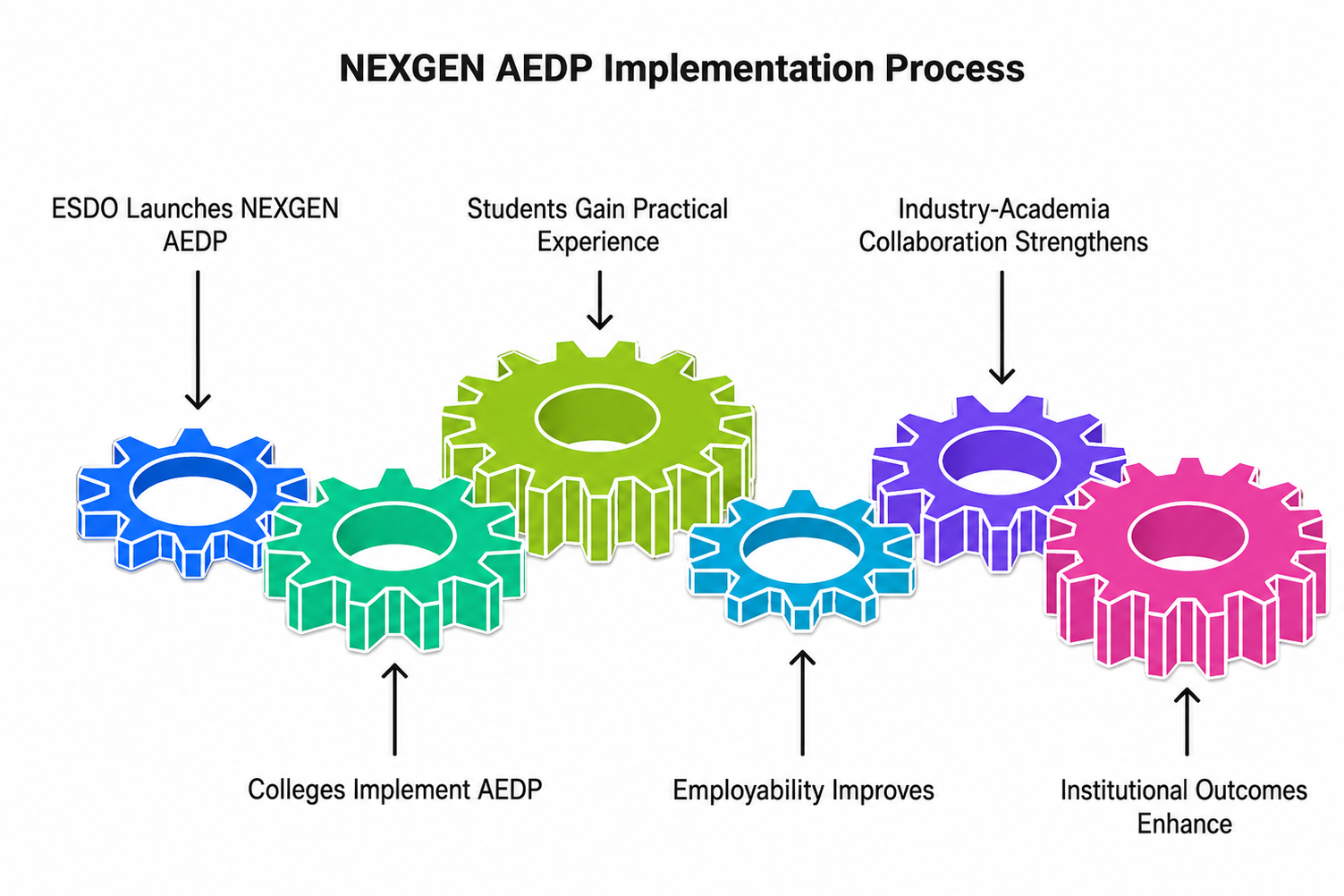
Implementation Process of AEDP
A structured, five-stage rollout from institutional approval to final degree certification — with clear milestones at every step.
Approval & Planning
College obtains approvals from Academic & Executive Councils. Prepares an Apprenticeship Plan with training structure, duration, learning outcomes, and assessment criteria.
Industry Partnership
College signs a Tripartite Agreement with the student and an industry partner. Agreements define roles, training plan, stipend, duration, and assessment methods.
Curriculum Integration
Theoretical and apprenticeship components aligned with NCrF. Apprenticeship embedded from 2nd semester; final semester fully dedicated to hands-on training.
Execution
Students undergo apprenticeships at industry sites, guided by faculty mentors and industry supervisors. Continuous mentoring, monitoring, and joint assessment.
Assessment & Certification
Evaluation via Industry (30%), Faculty Mentor (40%), and Viva/Seminar (30%). Degree awarded and credits updated on the Academic Bank of Credits (ABC) portal.
Roles & responsibilities
Responsibilities of Key Stakeholders
Four clearly defined roles ensure accountability, quality delivery, and compliance across the entire AEDP ecosystem.
Higher Educational Institution(College)
- Design curriculum jointly with industry
- Formalise agreements and approve programme internally
- Facilitate student placement with partner industries
- Assign faculty mentors and conduct academic components
- Monitor training, conduct evaluations, and award degrees
Industry / Establishment
- Sign MoUs and onboard students as apprentices
- Provide hands-on apprenticeship training at the workplace
- Pay stipends as per Apprentices Act or NATS/NAPS
- Participate in student assessment and provide feedback
Students / Apprentices
- Complete both academic and apprenticeship components
- Maintain discipline and performance at the workplace
- Submit training reports for faculty and industry review
- Appear for all assessments and viva/seminar evaluations
BOAT / Skill Council
- Provide technical assistance and registration support
- Facilitate onboarding on the NATS portal (if opted)
- Ensure compliance with government rules and norms
- Help route government apprenticeship incentives
Ready to transform your institution?
Join the growing network of UGC-compliant AEDP colleges. Align with NEP 2020 and lead your region in industry-integrated education.